If you moved here from another state, your old pool maintenance rules don’t apply. Florida pool care is an intense, year-round routine. The chemistry swings, the algae, the hard water scaling, the hurricane prep checklist: this is specific to where you live.
Pool care in Florida is genuinely different from pool care in Texas, California, or Tennessee. Some things are much harder here. Some things cost more. And you trade the cost of closing and winterizing your pool with year-round maintenance.
If you’re at a loss as to what to do with your new pool, Home Gnome connects you with local experts who know exactly how to handle the Florida climate. Otherwise, here is what you are up against.
What’s Different: The Big Picture
The single biggest difference between Florida pool ownership and anywhere else is this: Your pool never closes.
In Ohio or Minnesota, pools may only be usable for 3 to 4 months a year. Even in milder northern states like Tennessee, pools are closed for at least 6 months. The water gets balanced, the equipment gets winterized, and a heavy cover goes on. Nobody thinks about it again until April.
Florida pool owners don’t get that break. Your pool runs 52 weeks a year. That means 52 weeks of chemical management, UV exposure, debris cleanup, and constant equipment wear.
Sean Finnerty, owner and operator of Palm Beach County pool maintenance company Finn’s Pool Services, says the endless cycle eventually breaks people.
When asked what task homeowners neglect the most, Finnerty says, “regular water testing and chemical balancing.”
“Most homeowners start off checking their water every week, but after a few months life gets busy and they start testing less often,” he says. “In Florida, that’s usually when we start seeing algae, staining, or water that’s just harder to keep clear.”
On top of the burnout, those 52 weeks happen in a chemically unforgiving climate. You deal with intense UV radiation, mineral-rich hard water, and year-round algae pressure. Summer thunderstorms kill your chemistry overnight. Insects treat your pool like a public bath.
What’s Harder: The Florida-Specific Challenges
Florida vs. northern pool care at a glance:
| Feature | Florida Pools | Northern Pools |
| Operating season | 52 weeks | Around 4–6 months (open season) |
| Summer pump time | 8–12 hours/day | 6–8 hours/day |
| Winterizing | Never | Standard in freezing climates |
| Service routine | Weekly | Often biweekly |
1. Hard Water and Calcium Scaling
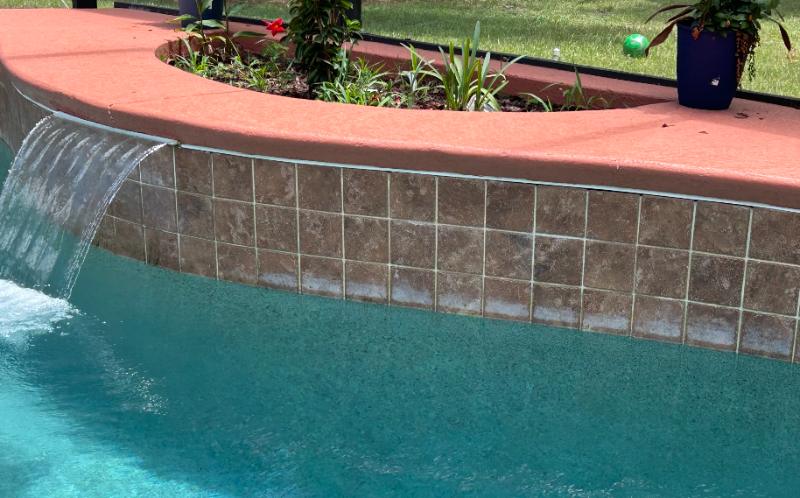
Florida’s water supply draws from the Floridan Aquifer, one of the most mineral-rich groundwater sources in the country. As water moves through deep limestone bedrock, it picks up high levels of calcium and magnesium.
What comes out of your tap in most Florida cities is technically “hard” to “very hard” water, and your pool feels every bit of it.
The result is calcium scaling. It’s that white, crusty buildup you see creeping up your tile line, coating your return jets, and forming inside your salt cell. It can shorten equipment life, reduce salt cell efficiency, and permanently etch plaster surfaces.
“Don’t ignore it when you first start seeing it,” Finnerty says. “A little bit of scale is much easier to deal with than years of buildup. Regular brushing around the tile line and keeping your water balanced goes a long way toward preventing those thick white deposits that can be difficult to remove later.”
2. UV Eats Your Chlorine Alive
Florida averages more than 230 sunny days per year, and that sun absolutely shreds unprotected chlorine. On a clear Florida summer day, an outdoor pool without a proper stabilizer can burn through most of its chlorine in just a few hours.
The solution is cyanuric acid (CYA), also called pool stabilizer. It bonds with free chlorine and shields it from UV degradation. Keep CYA levels between 30 and 50 ppm for standard chlorine pools, with 40 ppm as the sweet spot. For a saltwater pool, you should target 60–80 ppm.
The problem with CYA is that it accumulates over time and doesn’t evaporate. If it gets too high (above 80–100 ppm), it actually suppresses chlorine’s ability to sanitize, causing chlorine lock.
“The biggest thing is testing instead of guessing,” Finnerty says. “Florida sun burns through chlorine fast, so some stabilizer is important. The problem is when people keep adding stabilized chlorine products without checking their levels. Over time the CYA can creep up and make it harder for chlorine to do its job.”
3. Summer Thunderstorm Season
From June through September, Central and South Florida experience near-daily afternoon thunderstorms. They’re predictable, they’re intense, and they mess up your pool’s chemistry.
A heavy rain dump dilutes your chemicals, drops your pH and alkalinity, and loads the water with organic matter like pollen, algae spores, and debris that will overwhelm a clean pool in hours.
“First, remove any leaves, branches, and debris that found their way into the pool,” Finnerty says. “Second, test the water and make any chemical adjustments needed. Heavy rain can throw off the water chemistry and leave the pool looking cloudy if it’s ignored.”
This is why weekly professional service is the standard in Florida rather than biweekly. A lot can change in 7 days here. In off-peak months, some pools can stretch to biweekly without problems, but during storm season, weekly service is simply damage prevention.
4. Algae Never Really Takes a Break
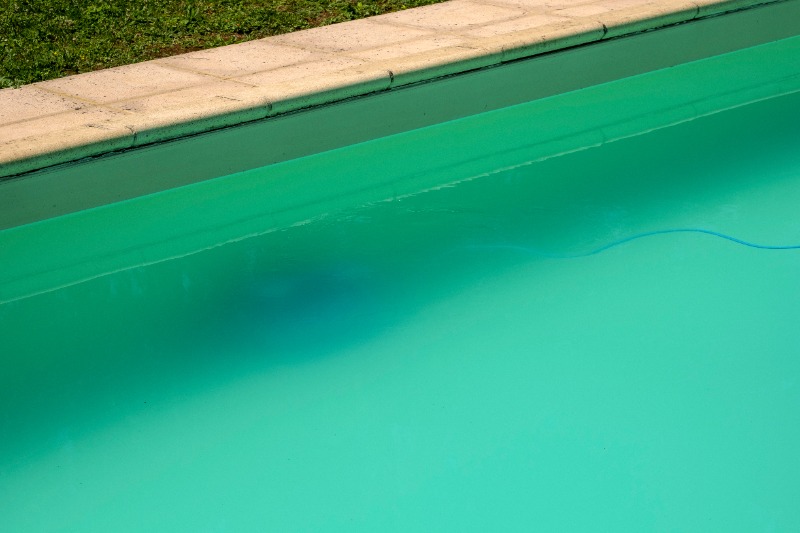
In colder climates, cold water stops the biological activity that causes algae blooms. In Florida, water temperatures rarely drop low enough to slow algae growth.
Any gap in your chemical balance — a week of rain, a missed service visit, an equipment failure — will turn a clear pool green before you know what hit you.
Finnerty says that letting your sanitizer drop is the biggest mistake.
“Letting chlorine get too low, even for a few days,” he warns. “Warm water, rain, and sunshine create perfect conditions for algae in Florida. Once it gets established, getting rid of it is a lot more work than preventing it in the first place.”
5. The Florida Bug and Wildlife Situation
Lovebugs swarm twice a year (April–May and August–September) and coat the surface of any open pool with their oily bodies. Pollen season drops a yellow-green film on the water that clogs skimmers. Palmetto bugs, frogs, anoles, and the occasional raccoons and snakes view your pool as a local amenity.
This is why pool cages and screen enclosures are nearly universal in Florida. An enclosed pool still needs chemical maintenance, but it sees way less debris and fewer bugs.
Under Florida Statute §515.27, every new residential pool must have at least one approved safety feature:
- A safety pool cover
- Exit alarms on doors with direct pool access
- Self-latching door devices
- An in-pool alarm meeting ASTM Standard F2208
A screen enclosure qualifies as a barrier, which is why they’re so prevalent, but homeowners can install other compliant options.
6. Hurricane Season Is a Pool Maintenance Category
From June through November, the Atlantic hurricane season requires Florida pool owners to prep their pool in ways that never occur to owners in landlocked states.
Before a storm:
- Don’t drain your pool because a full pool is actually more stable structurally. Empty pools can “pop” out of the ground when water-saturated soil pushes up from below.
- Balance your chemistry ahead of the storm.
- Remove all loose equipment and accessories that could become projectiles.
- Turn off and unplug electrical equipment.
After a storm:
- Skim large debris from the water before it sinks.
- Shock the pool to high free chlorine levels (10 ppm is a good target), then run the pump 12+ hours continuously to distribute chemicals and filter out suspended particles.
- If your filter is visibly clogged with heavy sediment, backwash before running at full speed.
- If you lose power, add liquid chlorine directly to the pool and brush the walls to distribute it manually. You can use a chlorine tablet floater to help maintain a baseline sanitizer level until the grid comes back online.
Pool cages and hurricane winds:
- Screen enclosures are built to Florida Building Code standards for wind loads. The structural frames are generally designed to withstand winds up to 130 mph but the screen panels themselves usually fail between 75 and 100 mph.
- Some cage designs under Florida Building Code require screens to be removed when winds exceed 75 mph to prevent structural failure. You will find these specific panels clearly labeled on the frame at installation.
- After any major storm, inspect your enclosure for bent framing, torn screen, or compromised fasteners before assuming it’s still performing its protective function.
The North Florida Exception: Jacksonville, Gainesville, Tallahassee
Everything above applies statewide, but North Florida has its own wrinkle that Central and South Florida pool owners don’t deal with: actual cold weather.
Jacksonville, Gainesville, Lake City, and Tallahassee can see nighttime temperatures in the 30s during December and January, and genuine freeze warnings are not unheard of.
This doesn’t mean you need to winterize your pool like a homeowner in Nashville does, but it does mean you need to manage things differently than your neighbors in Orlando or Tampa.
What “winter” pool care looks like in North Florida:
- Monitor for freezes: You don’t need to drain the pool or fully winterize the plumbing, but you should monitor for freeze warnings.
When temperatures approach 34°F, run your pump continuously through the night to keep water circulating, because moving water is much harder to freeze than still water.
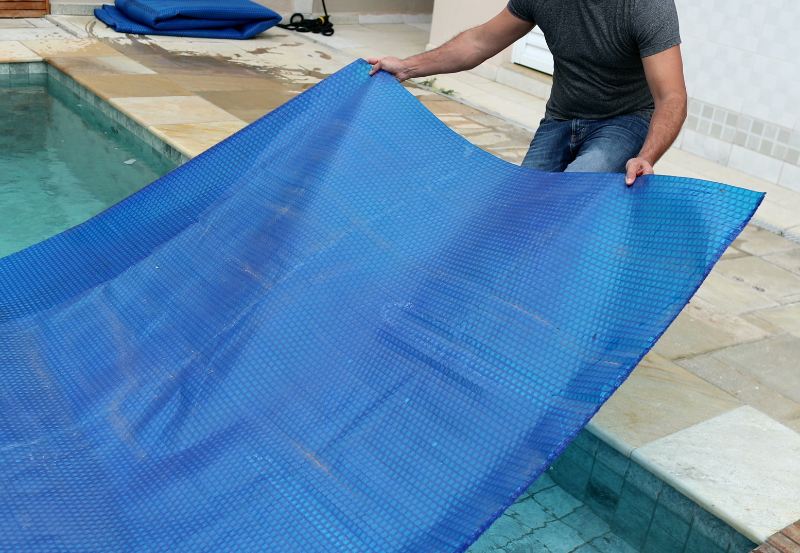
- Use a cover: A pool cover makes sense here in a way it doesn’t in South Florida. If you’re not using the pool for weeks at a time, a cover reduces heat loss.
It also slows evaporation and cuts down on debris and chemical demand during the quiet period. This is common in Jacksonville and Gainesville in January.
- Watch your water level: During any prolonged dry period, whether it’s Jacksonville’s drier winters or a brutal summer drought anywhere else in Florida, evaporation combined with reduced rainfall can drop your water level below the skimmer intake, which can burn out your pump motor. Check weekly and top off as needed.
- Reduce run times: The Florida Swimming Pool Association recommends reducing filtration run time to around 4-5 hours during the winter months. Dial back your chlorinator or salt generator accordingly.
What You Can Skip: Winterization
If you own a pool in Florida, you don’t need to winterize it.
Winterization means draining pipes, blowing out lines, adding antifreeze to plumbing, installing a solid cover, and walking away until April.
It’s a cold-climate process designed to protect pool equipment from freezing and cracking during months when the pool is completely unusable. None of those conditions applies in most of Florida.
What you do instead is adjust.
“Most pools don’t need as much chlorine during our cooler months because the water temperature drops and algae growth slows down,” Finnerty says.
“Many homeowners can also cut back their pump run times a bit. We still recommend regular maintenance year-round, but January and February are usually less demanding than the middle of summer.”
Bypassing winterization keeps real money in your pocket. Winterizing and reopening a pool adds $400–$800 a year in costs for owners up north. You completely avoid the expensive cycle of closing the pool every fall and reopening it every spring, like in colder climates.
FAQs
You fight 3 main algae in Florida: green, yellow (mustard), and black algae. Green algae spreads fast, yellow algae hides in the shade, and black algae is a nightmare because it anchors deep into porous plaster.
Warm water, intense sun, and frequent rain make all 3 algae types a constant threat, especially when chlorine levels slip.
Your water is full of heavy metals. Iron and manganese are everywhere, especially if you pull from a well or use mineral-heavy city water. These metals leave ugly brown, rust, or yellow marks all over your pool surfaces.
Adding more chlorine usually will not remove a metal stain, and in some cases, it can make dissolved metals stain faster by oxidizing them.
Coastal salt air can speed up corrosion on exposed pool equipment like pumps, heaters, fasteners, or any other metal parts that aren’t properly maintained.
Get Help With Year-Round Pool Maintenance
Florida pool ownership isn’t easier than pool ownership in other states, but it’s different in specific, manageable ways. The chemistry requirements are real, driven by hard water, UV intensity, and a year-round growing season for algae.
In the summer, you have to be ready to prepare your pool for a hurricane. And in winter, North Florida homeowners have to prepare for freezes. There is consistent upkeep, but what you get in return is a pool you can use every month of the year.
If the 52-week maintenance grind is burning you out, Home Gnome’s local pool care pros can help you handle the hard water, the summer storms, and the endless chemistry balancing so you can just enjoy the water.
Main Image: Florida pool care image, featuring a Florida-shaped pool being serviced by a pool cleaner. Image created with Gemini AI and Canva Pro.
Related Posts:


