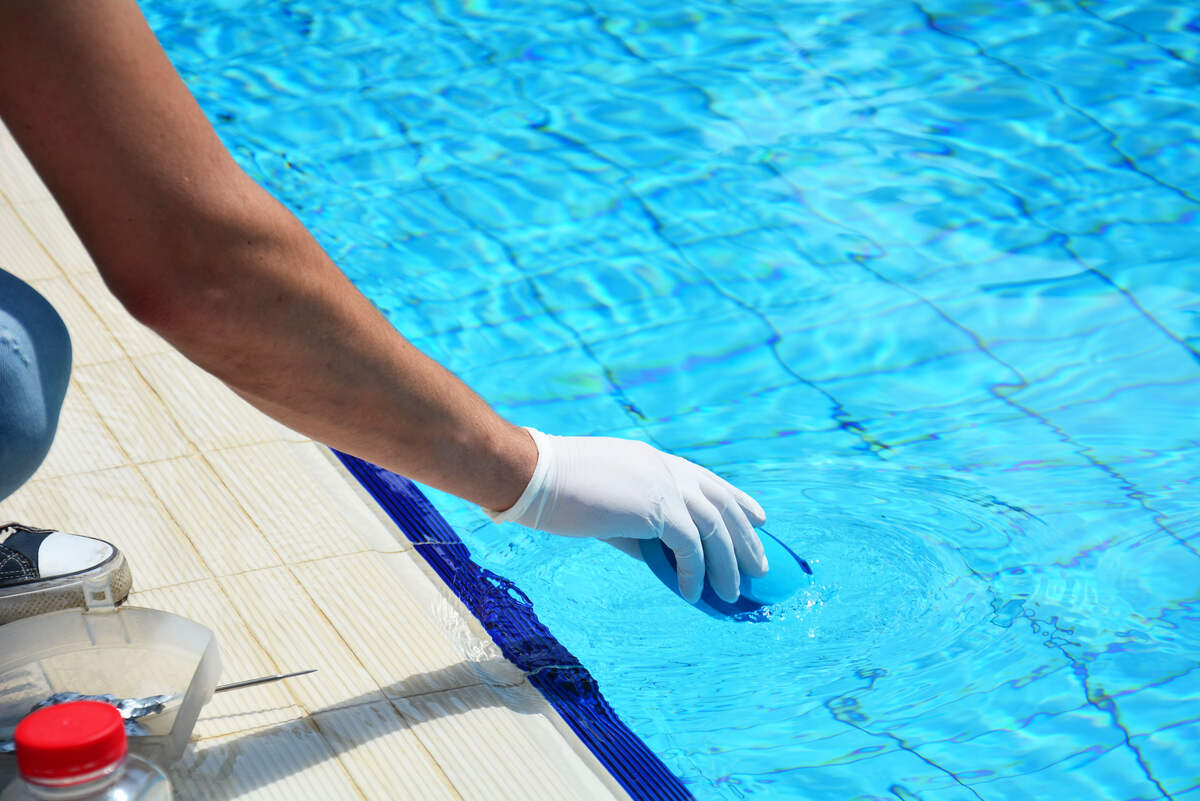
Testing your pool water may seem like a hassle, but it’s as simple as a kindergartener’s science experiment. So, before you dip a toe, check out this simple guide on how to test your pool water.
Most people use test strips because they are cost-effective, or the liquid test kit you inherited when you got your pool. Unsure how to test your pool water? Let’s dive in.
Using Pool Test Strips

Test strips are for sale at any pool store. You can buy strips that test for the basics, like pH, chlorinity, and salt. Or strips that test for metals in your pool, like copper and iron.
Testing your pool is a chemistry experiment, so don’t reuse strips or contaminate your findings with dirty fingers.
How to use pool test strips:
- Pull out a test strip and tightly reseal the bottle
- Draw water from the pool in a clean cup
- Dip your strip into the cup, then shake off the excess water
- Compare the color to the included guide on the bottle within 15 seconds
Some companies like Clorox have an app that reads your strip.
Here’s a chart of what to test for and the ideal ranges in parts per million (ppm).
| Indicators | Ideal range |
| Total hardness | 250- 350 ppm |
| Free chlorine | 1-3 ppm |
| Total chlorine | 1-3 ppm |
| pH | 7.4-7.6 ppm |
| Total alkalinity | 80-100 ppm |
| Stabilizer/Cyanuric acid | 30-70 ppm for chlorine and 50-70 ppm for salt |
| Bromine | 3-5 ppm |
Using Liquid Test Kits

Liquid test kits are more precise than test strips but a bit pricier, too. There are a few different kits, but the most common are the 5-way and 6-way test kits.
Here are a few tips to achieve an accurate reading:
- Take your water sample away from the jets and skimmer. Remember to dip the kit upside down and reach elbow-deep into the water before turning the kit over and bringing it to the surface.
- Take your sample while the pump is running.
- Add water to the fill line.
- Don’t touch anything that will contaminate your readings (dropper tips/ inside the vials).
How to test chlorine in the pool
- Add five drops of solution No. 1 (OTO (orthotolidine) with the yellow cap to the sample.
- Add the cap to the vile and turn the test kit upside-down a few times.
- Contrast the color of the vial against a white sheet of paper. The 5-way kit includes a remedy card with a white side that slides behind the samples for a precise reading.
- Compare the vial’s color with the color standards on the kit to get the free chlorine level.
How to test pH in the pool

- Add 5 drops of solution No. 2 (phenol red) with the red cap to the vial on the right.
- Add the cap and turn it upside down a few times.
- Compare the vial’s color with the color standards on the kit to get the pH level.
How to test for alkalinity
- Add 2 drops of sodium thiosulfate (1 of 3 green-capped bottles) to your sample.
- Swirl the tube.
- Add 5 drops of the Alkalinity reagent.
- Swirl the tube again.
- Add the sulfuric acid reagent one drop at a time, swirling the water after each drop. Count the number of drops as you go.
- When the mixture turns from green to red, stop adding drops.
- Multiply the number of sulfuric acid drops you used by 10 to get the total alkalinity of your pool (ppm).
How to test calcium hardness
- Add 20 drops of R0010 (1 of 3 blue-capped bottles) to the right-side vial.
- Swirl the mixture thoroughly.
- Add 5 drops of the reagent R011L.
- Swirl the mixture. It will turn a pinkish red.
- Add the caps and gently turn the test kit over a few times.
- Add R0012 while swirling the mixture. Count the number of drops it takes to turn the mixture blue.
- Multiply the number of drops by 10 to get the calcium hardness level in ppm.
How to test for phosphates in a pool
There are a few ways to test for phosphates in your pool. You can buy a test designed to check phosphates, buy a phosphate test kit, or take a water sample to your pool store.
If you use a phosphate pool kit, I recommend the Hannah or Nyos because they are the easiest to read.
Pro tip: Phosphate tests can be unreliable. Try the “red cap” test instead.
Pour a cap full of PR 10,000 phosphate remover concentrate into your pool. If the water becomes cloudy, your pool has phosphates.
Take a Water Sample to the Pool Store
Nobody wants to take a water sample to the pool store every week, but it’s an option for testing phosphates, nitrates, and metals in your pool.
Remember to take your sample from elbow-deep water, away from the jets and skimmer.
While you’re at the pool store, ask about test strips. They even sell strips to test saltwater pools.
FAQ
Test your pool water once a week unless you throw a pool party or experience heavy rainfall.
Yes. The reagents expire after about a year. Expired reagents result in faulty readings, so do yourself a favor and restock at the start of each pool season.
Yes. Even winterized pools need testing when air temperatures are above freezing.
Look Before You Leap
Being proactive about testing and adjusting your pool chemicals saves time and money but also allows your family to get the most out of your pool all summer. It prevents equipment damage, reduces the need for extra chemicals, and keeps your pool swim-ready all season long.
If you need a hand with your pool chemistry, Home Gnome delivers the best home service experience at the click of a button. Book reliable, skilled pool services and leave the rest to us.
Main Image Credit: YAHOES / Adobe Stock Free / License
Related Posts: