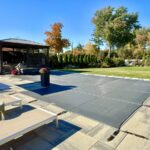
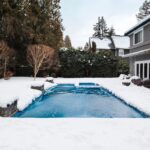
Picking the right pool cover depends on your main goal. A solar cover is best for heating. An anchored safety cover is best for off-season protection, while an automatic cover is best for daily convenience.
Figuring out the best fit means thinking about your pool, your budget, your weather, and what you really need the cover to do.
What Makes a Pool Cover a Safety Cover?
A real safety cover has to pass specific tests to earn that name. The standard is ASTM F1346-91, and it was created to help prevent drowning accidents involving kids under five years old.
For a cover to be sold as a safety cover, it must pass several tests:
- Weight test: The cover must be able to hold a minimum of 485 pounds. That’s calculated based on the weight of two adults plus one child during a rescue.
- Edge test: The cover must attach tightly all around. A kid cannot slip underneath between the cover edge and the pool deck.
- Water pooling test: The cover cannot let a dangerous puddle of water collect on top. Standing water is a drowning risk itself. This is why solid covers must have a pump or a drain panel to be ASTM certified.
Covers that fail to meet the ASTM standards, such as solar covers or generic tarps, provide zero safety benefits.
Solar Pool Cover

Best for: Pool owners on a low budget who want to heat their pool and swim longer. You MUST have a safety fence.
Cost: $30 – $225
A solar cover, often called a “bubble cover,” looks like a giant sheet of bubble wrap. It floats on top of the water to warm the pool.
The main job of a solar cover is to trap heat from the sun. It also stops water from evaporating, which saves you water and chemicals. According to Jeremy Yamaguchi, CEO at Cabana, solar covers “actually do work pretty well with trapping heat from the sun.”
Yamaguchi warns that “Probably the number 1 mistake people make with them is putting them upside down. This renders them practically useless with heat retention.”
Pros:
- It can heat the water by 5 to 15 degrees using the sun.
- Stops up to 95% of water evaporation. This saves you money on water and heating bills.
Cons:
- It’s not a safety cover. It’s a severe drowning hazard for children and pets.
- It’s a hassle to get on and off.
- It can fall apart after 3 to 5 years in the sun.
Winter Pool Tarp Cover

Best for: Pool owners on a budget who already have a safety fence.
Cost: $75 – $250
Winter pool covers are made for the off-season. They are typically solid, tarp-like covers made from a tough polyethylene material.
These covers are spread across the pool and held down with water bags (for in-ground pools) or a cable and winch system (for above-ground pools). Their job is to keep debris, leaves, and sunlight out of the pool while it’s closed. This makes opening your pool much easier in the spring.
Like solar covers, standard winter covers are not safety covers. This is one area where you should avoid cutting corners. Buying a used cover might seem like a good deal, but it often leads to regret. “Even if you want to buy an inexpensive cover, you should still buy a new one,” says Yamaguchi. “A new one won’t have been affected by chemicals, the sun, or pests yet.”
Pros:
- It’s budget-friendly.
- It keeps leaves and sunlight out.
Cons:
- It’s not a safety cover.
- Rain and wet leaves collect on top.
- Water bags can leak, break, and are hard to store.
- It’s thin and only lasts 1 to 3 seasons.
Automatic Pool Cover

Best for: Pool owners who want the ultimate convenience and daily safety.
Cost: $6,000 – $20,000
An automatic cover is the most convenient option. With the turn of a key or the press of a button, a solid vinyl cover rolls out along tracks to cover your pool.
These provide excellent safety, keep debris out, and are fantastic at retaining heat. Because they are so easy to use, owners tend to keep their pools covered more often. This leads to big savings on heating, chemicals, and water.
Besides convenience, they add serious security. “Automatic pool covers are a lot more secure,” explains Yamaguchi. “They will stay exactly in place, essentially ‘locked’ over top of your pool. This makes them more effective at covering the entire surface the whole time they are on there. That also makes them better at preventing animals and people from accidentally falling in the water.”
Unfortunately, automatic pool covers are mostly limited to rectangular pools. “A non-rectangular shape or having unique features that stick up can make it a lot more difficult to get a pool cover,” Yamaguchi explains. “Often, you’ll have to get a custom cover. These kinds of pools also often can’t easily get automatic covers because those typically require a straight track.”
Pros:
- Very easy to use.
- It’s ASTM F1346-91 certified for safety.
- It’s excellent at retaining heat, water, and chemicals, which lowers operating costs.
Cons:
- This is the most expensive option.
- It requires a cover pump for rain.
- The vinyl fabric wears out and needs to be replaced, which is a major expense.
Mesh Safety Cover

Best for: Pool owners who want safety and low winter maintenance.
Cost: $1,000 – $3,000
This is the first type of true safety cover. It is made of a woven mesh fabric that is pulled tight across the pool with springs, like a trampoline. The cover is anchored securely into the pool deck. If you don’t know how to install it, read our How to Install a Pool Cover on Your In-Ground Pool article.
Its main feature is that rainwater and melted snow drain right through the mesh. This means you do not need a cover pump to remove standing water.
For areas with heavy snow, mesh is often the top recommendation. “Mesh would be my recommendation,” says Yamaguchi. “When snow accumulates, it gets very heavy, very fast. If your pool cover is solid, that accumulation has nowhere to go, so it can weigh down the cover and potentially damage it. With mesh covers, however, the snow has a chance to melt and then drain through, which reduces the weight that stays on the surface of the cover.”
Pros:
- It’s ASTM F1346-91 certified for safety.
- Lightweight and easier to handle than solid covers.
- It can last 10 to 15 years.
Cons:
- It lets in fine silt and some sunlight.
Solid Safety Cover

Best for: Pool owners who want the cleanest possible spring opening, live in areas with heavy debris, and are willing to maintain a cover pump.
Cost: $1,800 – $3,600
This is the other type of true safety cover. It’s made of solid vinyl and anchors to the deck just like a mesh cover. The main difference is that it blocks 100% of sunlight, water, and debris. This means your pool water is crystal clear in the spring. This cover’s biggest drawback is that it requires a pump.
“One simple tip is just to remove standing water from the top of the cover,” Yamaguchi advises. “The longer standing water pools up on top, the more strain that puts on the cover, which can weaken it over time.” To learn how to solve this issue, read our How to Get Water Off Your Pool Cover article.
Pros:
- It’s ASTM F1346-91 certified for safety.
- It blocks 100% of sunlight, stopping all algae growth.
Cons:
- It requires an automatic cover pump to remove rainwater and snowmelt.
- It’s significantly heavier and harder to handle than mesh.
- It has a shorter lifespan than mesh, usually 7 to 11 years.
Hybrid Safety Cover
Best for: Owners who want a clean opening without a pump.
Cost: $1,000 – $2,500+
A hybrid safety cover is mostly a solid vinyl cover but has one or more mesh drain panels built into the middle. This design blocks most of the sunlight like a solid cover. It also lets rain and snowmelt drain right through, just like a mesh cover.
Pros:
- It’s ASTM F1346-91 certified for safety.
- It blocks most sunlight, stopping almost all algae growth.
- You get a much cleaner spring opening than with mesh.
- No cover pump is needed.
Cons:
- It’s heavier than a standard mesh cover.
- It still lets in some fine silt and dirt through the drain panel.
FAQ About Pool Covers
For safety and durability, a safety cover (either mesh or solid) is an excellent choice. If convenience is your top priority, an automatic pool cover is the best.
A standard winter cover (tarp style) is the most common choice for closing an above-ground pool. For the swim season, a solar cover is great for heating the water and reducing evaporation.
A dedicated winter cover or a safety cover (mesh or solid) is best. These are built to handle snow and off-season debris. An automatic cover is not typically designed to be a winter cover and can be damaged by heavy snow.
An anchored safety cover (mesh or solid) or an automatic pool cover is best for safety. These are specifically designed to prevent people or pets from falling into the water.
A solid safety cover or an automatic cover is the best. They block 100% of debris, leaves, and even fine dirt. A mesh cover stops large debris but may let small particles through.
Your Perfect Pool Cover
Choosing the right cover comes down to your budget, your pool, and your main priorities, whether that’s safety, convenience, or just heating the water. It’s a common misconception that all covers are the same. The most important thing is to know what you’re buying.
Yamaguchi says, “While certain types of covers are certainly more effective than others, the truth is that you can make any type, with any budget, work if you have to. As long as you maintain it well and handle it properly, it’s okay to get a cheaper pool cover compared to a fancy automatic one if that’s what your budget can handle.”
If you’re feeling overwhelmed by the options, we can help you connect with an experienced pool pro in your area who can look at your pool and find the perfect cover for your needs.
Home Gnome delivers the best home service experience at the click of a button. Book reliable, skilled services in seconds and leave the rest to us.
Read More:
Main Image: Swimming pool cover for protection against dirt, leaves, heating and cooling water. Photo Credit: lara-sh / Adobe Stock
Related Posts: