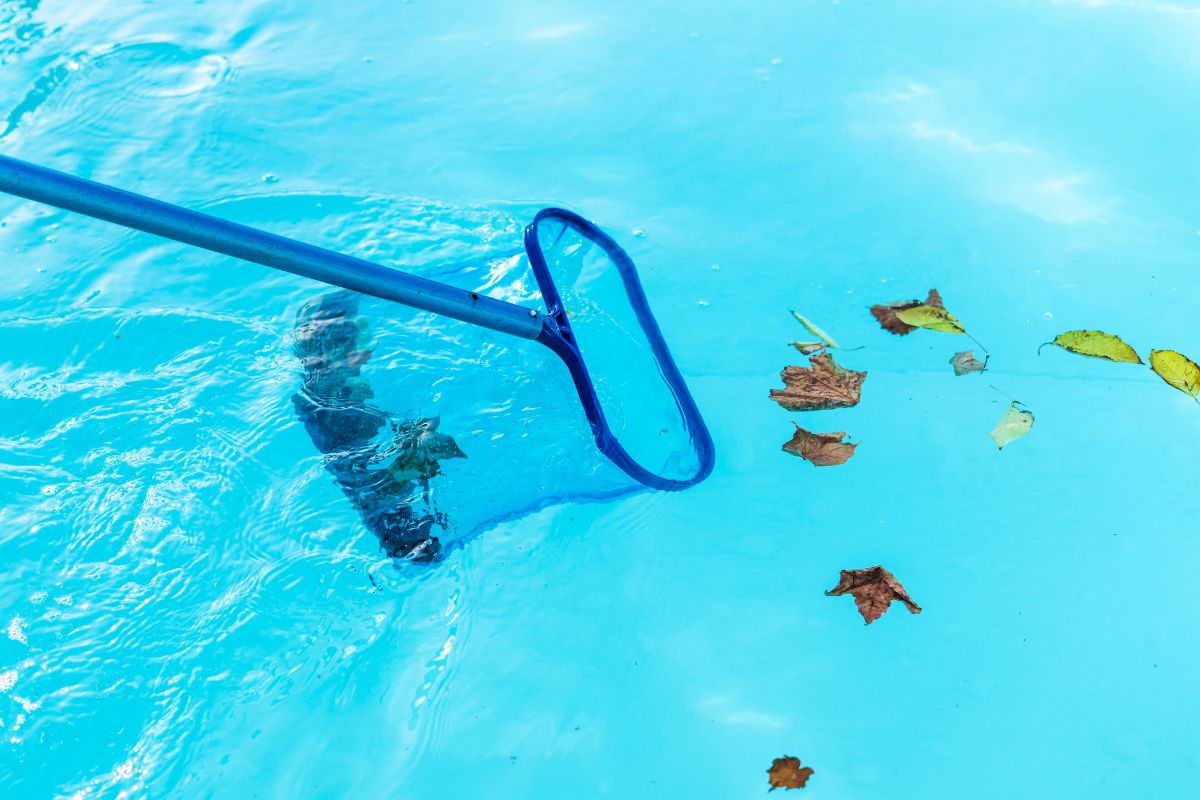
To get leaves out of your pool, you can scoop them out manually with a deep-bag leaf rake, use a manual or automatic pool vacuum to suck them up, or optimize your pool’s built-in skimmer system to catch them before they sink.
The best method depends on how many leaves are in the pool and what tools you have. For heavy leaf loads, always start by manually raking out the bulk of the debris first.
How to Remove Leaves Manually (Without a Vacuum)
| Project Difficulty: Beginner Estimated Time: 15 to 60 minutes Project Cost: $20–$80 (for a leaf rake or leaf gulper) |
Manual removal is often the first and most important step, especially when dealing with a large volume of leaves. To minimize debris before it even starts, check out our article on How to Keep Leaves Out of Your Pool.
Use a Leaf Rake
A standard flat skimmer net is fine for grabbing a handful of leaves from the surface, but you need a leaf rake for anything more. A leaf rake has a deep, bag-like net that can hold a big volume of debris without spilling everything back into the water.
How to use it:
- Push the rake slowly across the bottom of the pool.
- Gently bounce the leading edge on the pool floor to create a current that lifts the leaves and funnels them into the net.
- When you reach the wall or the end of your pass, flip the rake quickly and give it a short, sharp pull toward you to trap the collected leaves deep inside the bag.
- Once it’s full, lift it straight up and out quickly, and dump the contents into a nearby trash can to minimize dripping messes on your deck.
Here’s a quick video showing exactly how to use it like a pro:
Use a Leaf Gulper for Heavy Sludge
For some heavy piles of sunken or decomposing leaves, a pool leaf gulper (also called a leaf bagger or leaf eater) is an excellent tool. This vacuum head attaches to a telescopic pole and a garden hose.
The water pressure from the hose creates a venturi effect, lifting leaves and heavy debris from the floor into an attached mesh bag. Because it doesn’t use your pool’s filtration system, you can remove a massive amount of debris without straining your pump or filter.
How to use it:
- Connect the gulper to your pole and garden hose.
- Move it over the piles of sludge to vacuum them up.
Here’s a quick video showing exactly how to use it like a pro:
The main problem with the leaf gulper is that it constantly adds fresh water to your pool, which can alter your water balance. A trick to solve this issue is to power it with a small, submersible utility pump placed in the pool’s shallow end to use your pool’s water.
How to Remove Leaves with a Pool Vacuum
| Project Difficulty: Beginner Estimated Time: 30 minutes to 3 hours Project Cost: $50 to $1000+ (for vacuum equipment or an automatic cleaner) |
After removing the bulk of the leaves, you can use an automatic pool cleaner to remove the remaining debris.
Automatic Pool Cleaners
For automated cleaning, pressure side and robotic cleaners are best for leaves. Suction-side cleaners tend to clog easily with anything more than light debris.
- Pressure-side cleaners connect to a return jet and use water pressure to move around, collecting leaves in their own filter bag. They are excellent for pools with heavy debris.
- Robotic pool cleaners are self-contained units that operate independently of your pool system. They are powerful, efficient, and great at picking up all types of debris.
“This is one reason why I really like robot pool vacuums,” says Jeremy Yamaguchi, CEO of Cabana. “They can run automatically and help keep your pool cleaner 24/7. They help prevent leaf buildup and thus help prevent leaves from starting to decompose.”
Read More: Handheld and Manual Pool Cleaners: Types and How to Choose.
How to Remove Leaves with Your Pool’s Built-In Systems

| Project Difficulty: Beginner Estimated Time: Ongoing (a few minutes of daily maintenance during leaf season) Project Cost: $0–$20 (for skimmer socks) |
Your swimming pool has built-in features to deal with leaves: the skimmer and filtration system.
While they won’t handle a whole pile of soggy leaves on the bottom (that’s where manual or vacuum methods are needed), using your pool’s circulation can minimize leaf accumulation and make cleanup easier.
Here are ways to leverage your pool’s own system:
Maximize surface skimming: Your pool’s skimmer is designed to grab any floating debris, so ensure it can do its job. Keep your water level about mid-skimmer opening. Check that your skimmer weir (the little flapper door) is present and moving freely. The weir helps draw in leaves and then traps them in the skimmer when the pump shuts off, so they don’t float back out.
Optimize water circulation: Adjusting your return jets can “encourage” leaves to go into the skimmer. Aim the return eyeball fittings to create a gentle circular flow around the pool.
Run your pump longer during peak leaf-fall days: More circulation time means the skimmer has more opportunities to catch leaves before they sink. If you normally run 8 hours, you can run it for 12+ hours for a week or two in late fall when your pool gets bombarded with leaves.
Main drains and built-in floor systems: In-ground pools have a main drain at the deep end. As leaves sink, the main drain could pull some into the filter system, but the grate prevents large objects (like big leaves) from going through, and they often just accumulate around the drain cover. You can use a pool brush to sweep these toward the drain or scoop them with a leaf rake.
To keep your pool filter performing, read our guide on How Often to Clean Your Pool Filter.
How to Get a Lot of Leaves Out of a Pool
| Project Difficulty: Beginner Estimated Time: 2–5 hours Project Cost: $50–$150 (for tools like a rake, gulper, and leaf canister) |
When your pool is completely covered in leaves, don’t go straight for the vacuum. This only clogs and damages your equipment.
“I would definitely start with a leaf rake,” advises Yamaguchi. “For the same reason why you should manually scoop out the leaves from your gutter first, or why you should empty your food scraps in the trash before washing your dishes, it just helps to clear as much out by hand first. It reduces stress on your vacuum and actually just ends up being easier.”
Follow this step-by-step plan:
- Start with manual raking: Use a deep bag leaf rake to remove the top layer and the bulk of the large leaf piles from the floor. Focus on getting the big stuff first.
- Use the leaf gulper: For the dense, heavy, wet leaf piles that remain, use a leaf gulper. It will remove this sludge-like material without sending it through your filter.
- Use the vacuum: Only after 90 to 95% of the leaves are gone should you use a vacuum. It can easily handle the fine debris and small leaves left behind.
- Check baskets: After you are done with the leaves, check and empty your pump and skimmer baskets.
FAQ
For a large quantity of leaves, a deep bag leaf rake is the fastest manual tool to remove the bulk of the debris. For smaller, routine cleanups, a robotic pool cleaner offers the fastest automated cleaning.
The best way to deal with decomposing leaves in your pool is to remove them quickly before they start to break down. You can use a pool skimmer net to scoop the leaves off the surface and a pool vacuum or leaf rake to get the leaves from the bottom.
Use plastic tools like a snow shovel and push broom to remove the bulk of the leaves. Use a shop vac to clean up the fine dust at the end. Don’t use a pressure washer because it can damage the pool’s wall.
Remove any standing water from the cover using a pump or a siphon. Then, use a leaf blower for dry leaves or a non-metallic rake and brush for wet, sticky leaves.
Leaves in a pool can be reduced, not stopped completely. A pool cover or a leaf net will catch most leaves before they fall in. Place pool noodles or water tubes along the cover edges to seal gaps near waterfalls or other openings. Trimming nearby trees also helps reduce the number of leaves falling in.
The Final Scoop on Pool Cleanup
Dealing with leaves is a routine part of pool ownership, but having the right tools and strategy makes it a rather easy task instead of a major chore. Whether you’re doing a quick daily skim or a post-storm cleanup, you can keep your water clear and inviting.
If you’d rather spend your time swimming than scooping, let us help. Pool Gnome connects you with experienced, local pool care pros who can handle all the seasonal cleanup for you.
Home Gnome delivers the best home service experience at the click of a button. Book reliable, skilled services in seconds and leave the rest to us.
Read More:
- How to Clean a Pool Filter
- How to Get Pollen Out of Your Pool
- How to Manually Vacuum a Swimming Pool
- Pros and Cons of a Robotic Pool Cleaner
Main Image: A blue pool net scoops leaves from the water. Photo Credit: Ria / Adobe Stock
Related Posts:


