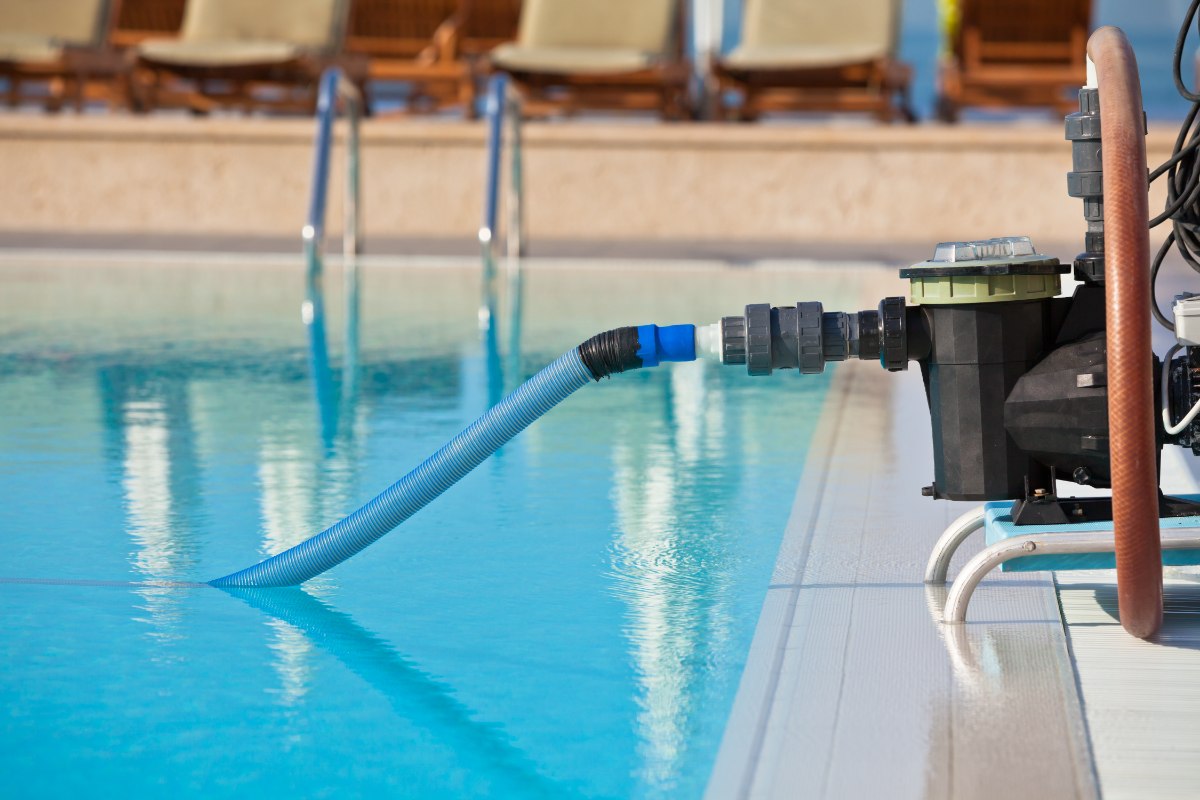
You should run your pool pump long enough to filter all the water at least once a day. For most pools, this is about 8 hours. This time changes based on your pool size, pump type, and the season.
To strike the right balance between clean water and energy bills, consider hiring a pool pro. They’ll determine the ideal runtime for your pool, avoiding cloudiness and algae. This way, you can save money and have clean pool water without any worries.
General Guidelines
Most new pool owners follow a simple rule: keep your pump running roughly eight hours a day. This is a pretty good starting point, but it doesn’t work with every pool in every situation. It is more accurate to calculate the specific needs of your swimming pool.
Pool Pump Run Time Calculator
Pool Pump Run Time Calculator
Calculating your pool’s turnover rate is the best way to find your ideal runtime. This is how long it will take for all the water in your pool to be filtered through once.
You need to first find your pool’s volume in gallons. If you don’t know this, you can use a simple formula:
- Rectangular pools: Length x Width x Average Depth x 7.5 = Total gallons
- Round pools: Diameter x Diameter x Average Depth x 5.9 = Total gallons
- Oval pools: Length x Width x Average Depth x 6.7 = Total gallons
Next, find your pump’s flow rate. This is usually on the pump’s label or in the manual.
With those two numbers, you can find your turnover time.
(Pool Volume in Gallons / Pump Flow Rate in GPM) / 60 = Hours for One Turnover
For example, a 20,000-gallon pool with a 40 GPM pump needs to run for about 8.3 hours to achieve one turnover.
Keep in mind that one turnover doesn’t get your water completely clean. Because filtered water mixes with unfiltered water:
- After 1 turnover, about 63% of the water is filtered.
- After 2 turnovers, about 86% of the water is filtered.
- After 4 turnovers, about 98% of the water is filtered.
This effect is due to the fact that the circulation and mixing are continuous instead of replacing the entire water with one clean batch.
How Long to Run a Pool Pump by Season
You’ll need to adjust your pump’s runtime as the weather changes:
Summer: During hot summer months, you should run your pump for 10 to 12 hours a day. The heat and sunlight encourage algae growth, so your filter needs to work harder. For more details, see our article on When and How Long to Run Your Pool Pump in Summer.
Winter: In the winter, you can reduce the runtime. Jeremy Yamaguchi, CEO at Cabana, suggests a simple rule: “For most people, the general rule to follow is to run your pool pump for 1 hour for every 10 degrees of outside temperature. If it’s 40 degrees out, for example, that would mean running it for 4 hours.”
If you live where it freezes, you need to take extra care. “With freezes, the rule is to run the pump constantly,” says Yamaguchi. “That constant water flow helps prevent the water from stopping and freezing and thus expanding and causing damage.” You can find more winter tips in our guide on how long to run your pool pump in winter.
Spring and Fall: During the milder spring and fall seasons, a runtime of 6 to 8 hours a day is usually sufficient to keep the water clean.
How Long to Run Single-Speed vs. Variable Speed Pumps
Single-Speed Pumps
You should aim for 1 to 2 turnovers per day. This usually translates to running the pump for 6 to 12 hours, depending on the size of your pool and the flow rate of your pump, and if your water chemistry is good. If your pool’s chemical balance is off, you may need to run the pump longer to keep the water clean.
You can also split the run time. For example, run it for 4 hours in the morning and 4 hours at night. This keeps the water moving and helps it stay clean.
Variable-Speed Pumps
You can run longer at a lower RPM to achieve the same turnover for far less energy. This efficiency leads many owners to run them 12 to 24 hours a day, but this begs the question: Is It OK to Run a Pool Pump 24 Hours a Day? With a variable-speed model, it is, and it has many benefits:
- The water is always moving, which means better filtering.
- The pool surface stays cleaner because the skimmer is always working.
- Pool chemicals are always mixed well in the water.
You should run the pump at a low speed for most of the day, then run it at a higher speed for 3 to 4 hours in the afternoon. This helps with heavy cleaning, and it also ensures that other equipment gets enough water flow to turn on.
Signs Your Pump Isn’t Running Long Enough

Sometimes it’s hard to tell if your pump is not running long enough, but there are some signs you can use. If any of these problems start happening, you should try increasing your pump run time and see what happens.
Cloudy Water
The most common sign of poor filtering is cloudy water. If your water looks hazy or dirty, it may be a sign that your pump needs to run more. The filter can’t work properly if it doesn’t get enough time to pull the small dirt particles from the water.
Algae Growth
Algae forms in warm, stagnant water with low chlorine levels. When the pump is off, “dead spots” can form in your pool, and algae loves to grow in these spots. The only way to prevent algae from growing in these areas is to keep the water moving.
Debris on the Bottom
The pump’s job is to pull leaves and insects into the skimmer basket. If the pump is off for an extended period, this debris can sink to the floor before it can be filtered out.
Unstable Chemical Levels
The pump acts like a big spoon, and it mixes chemicals evenly into the water. If your pump is not running, some parts of your pool will not have enough chlorine.
Signs Your Pool Pump Is Running Too Much
It’s hard to run a pool pump too much from a mechanical standpoint, as modern pumps are built for continuous use. As Yamaguchi says, “There may not really be any clear signs of running the pump too much other than a high bill.”
Any real damage to a pump motor is usually caused by specific problems and not just from long hours. These include overheating from poor ventilation, running the pump without water, or blockages that cause the motor to strain.
If your pump is damaged beyond repair, you will need to consider replacement.
Read more: How Much Does It Cost to Install a Pool Pump?
FAQs About Pool Pump Runtime
Running your pump during the day is best. The sun is out, the water is warm, and it’s when algae grows the fastest. Circulation helps stop algae and spreads chlorine when the sun is burning it off.
After shocking your pool, you should run the pump for at least 8 hours, or overnight. This ensures the chemicals are fully circulated.
The recirculate setting bypasses your filter. It just moves water around the pool. You use this setting when you add certain chemicals that you don’t want getting stuck in the filter, like a flocculant. You only need to run it on recirculate for a few hours to mix the chemicals, then you should switch it back to the filter setting.
Yamaguchi says, “There may not really be any clear signs of running the pump too much other than a high bill.” Modern pumps are designed to run for long periods.
Yes, it is generally safe to run your pump in the rain, as long as your equipment is properly installed and protected from flooding. It can help filter out the extra debris that rain washes into the pool.
Home Gnome delivers the best home service experience at the click of a button. Book reliable, skilled services in seconds and leave the rest to us.
Main Image: Pool pump filtering and circulating water. Image Credit: dvoevnore / Adobe Stock
Related Posts: