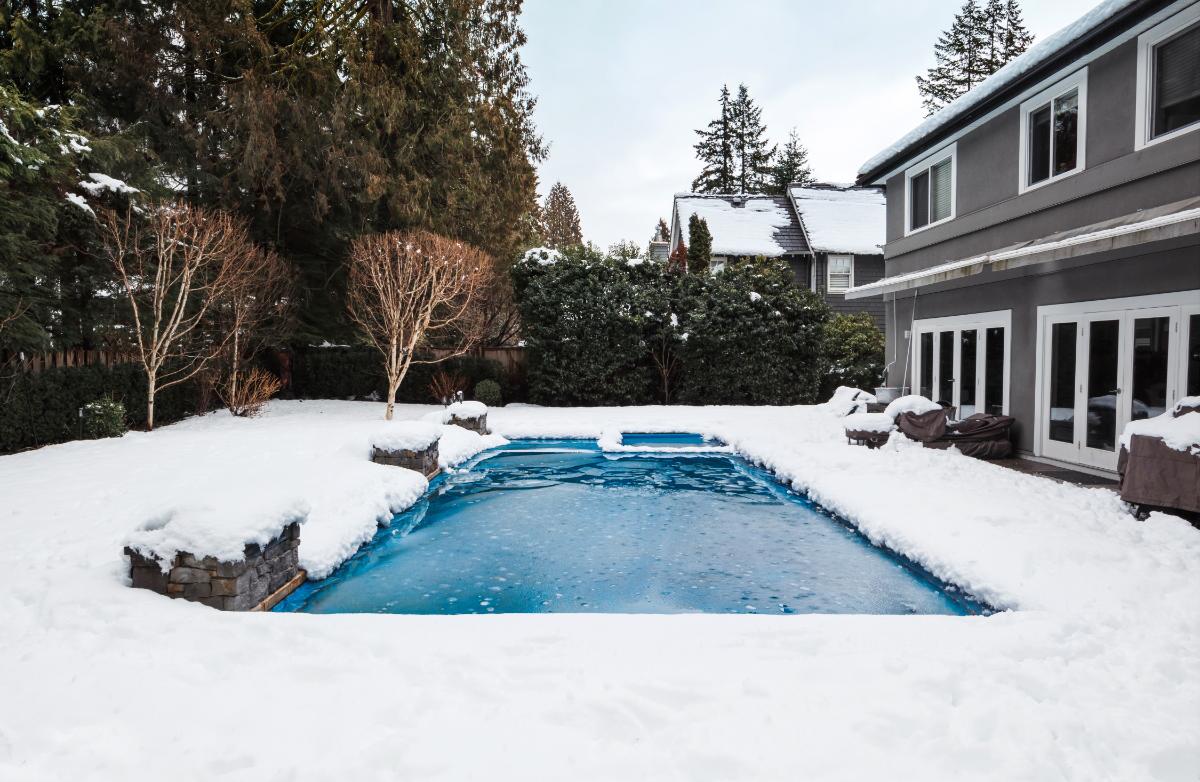
To keep your pool in perfect shape during the winter, you should do a few quick checks every few weeks. The main checks are: balance the water, keep the cover clear of any debris, keep an eye on the water level, and inspect your equipment.
Is Your Pool Ready for Winter?
Before you begin your winter maintenance routine, you should ensure that your pool is properly closed for the season. If you haven’t closed your pool yet, check out our guide on When to Close Your Pool.
A complete winterization includes:
- Deep-clean the pool and balance the water chemistry
- Lower the water level below the skimmer
- Drain out all the equipment and clear out the plumbing lines
- Add winterizing chemicals to the water
- Install a winter cover
For more detailed instructions, check out these guides:
- How to Winterize Your In-Ground Pool
- How to Winterize Your Above-Ground Pool
- How to Winterize Your Saltwater Pool
Test and Balance Water Chemistry
Even in a cold, covered pool, the water chemistry can become unbalanced, which can lead to corrosion, staining, and damage to your pool surfaces and equipment. You should test the water every two to three weeks to catch potential problems early.
Pull back a corner of the cover to get a water sample. Use your test kit and adjust the chemicals to these winter ranges:
- pH Level: Between 7.4-7.6
- Total Alkalinity: 80 to 120 ppm
- Calcium Hardness: 200-400 ppm
- Chlorine Levels: 2-4 ppm
Keep the Pool Cover Clean and Secure

Your pool cover protects your pool from the worst of winter. Pool pro Jeremy Yamaguchi, CEO at Cabana, notes that even small amounts of debris can cause problems: “If there is debris built up on the cover, that could possibly lead to problems like bacteria or mold growth.”
- Remove debris and water: The weight of water and debris is the main cause of cover damage. Use a soft broom or leaf blower for dry leaves and a cover pump to remove any standing water from rain or snowmelt.
- Manage snow: Don’t let more than a foot of snow build up. You can use a roof rake or push broom to safely clear heavy loads. Never use a sharp metal shovel.
- Inspect for damage: When you’re cleaning the cover, also check for any small rips or tears. If you find any, use a pool cover patch kit to fix them.
Read more:
Manage the Pool’s Water Level
The water in your pool does an important job over the winter: it pushes back against the ground to prevent damage.
As Yamaguchi explains, “Inexperienced homeowners may assume that pools should be completely drained in the winter because they aren’t in use, but that’s wrong. The problem with that is that it can cause a pool to crack, which is extremely costly to fix. In-ground pools receive a ton of pressure from the surrounding ground, and being filled with water essentially counteracts that pressure and helps prevent cracking.”
The ideal water level depends on which type of pool cover you use:
- For mesh covers: Keep the water level about 12 inches below the skimmer. This allows rain and snowmelt to pass through without overflowing the pool.
- For solid covers: Keep the water level about 6 inches below the skimmer. This is high enough to support the cover if it gets heavy with snow.
- For above-ground pools: An air pillow is a must-have. It sits under the cover and creates a dome shape that helps shed water and protects the walls from ice damage.
Check Equipment and Safety Features

A quick walk around your pool pad every few weeks can save you from major headaches in the spring.
Yamaguchi says one of the most overlooked checks is simply making sure the skimmer is dry. You should “check to see that the water level is below the skimmer. You want that to be totally empty to prevent water from getting in there and freezing, causing extensive damage within the system.”
What to look for:
- Equipment: Look for cracks in the pump, filter, and heater. Make sure all winterizing plugs are still tight and in place. After a thaw, briefly remove drain plugs to ensure no water has collected inside.
- Safety: Check that your fence is sturdy and the gate latches properly. Ensure all drain covers are still secure.
Brush Your Pool to Prevent Stains
Even in a covered and closed pool, it is only a matter of time before fine dust and microscopic algae find their way to the walls and floor over winter. If not addressed, this film, and ultimately stains, will become a surprise for you come spring.
To prevent this, you should brush your pool every 3 to 4 weeks. Simply peel back a corner of the cover, use a pole brush with a long handle to sweep these surfaces, and put the cover back on. This will help to keep the particles suspended in the water where your chemicals can neutralize them.
FAQ About Winter Pool Maintenance
Yes. The main difference is the importance of the air pillow underneath the cover that keeps your walls safe from damage from ice expansion if ice forms on the top of the pool. You should also check the frame every now and then for buckled walls, bent uprights, or height loss from snow load, as these often require complete pool replacement.
The ongoing maintenance is exactly the same. Your salt cell should have been cleaned, removed, and stored indoors before closing because salt generators do not function properly below 60 degrees F, and do not work at all below 50 degrees F. That means, like traditional pool owners, you will have to manually check sanitizer levels and add chlorine throughout winter.
It’s worth mentioning that cold weather may also give you false low-salt readings on your generator display.
For a fully winterized and closed pool, you should not run the pump at all. It should be off and drained. For pools kept open in mild climates, Yamaguchi says, “the general rule to follow is to run your pool pump for 1 hour for every 10 degrees in temperature it is.”
Yes, some water does evaporate, but the amount is minimal with a quality cover. If you notice a big drop in the water level, that’s not from evaporation. The more likely cause is a small leak in the pool’s liner or plumbing.
The best way is to regularly remove any water collected on top because that’s the usual sign of too much weight from rain or snowmelt. A correct water level in the pool provides essential support from underneath. An air pillow under the cover is the best method for above-ground pools to prevent any sagging.
Set Yourself Up for an Easy Spring
There is no substitute for a consistent winter maintenance routine. A few minutes every few weeks will protect your investment and save you from a lot of work and expense when the swimming season returns.
If you’d rather skip the winter check-ups, we can help you connect with experienced pool pros in your area to make off-season pool care easy.
Home Gnome delivers the best home service experience at the click of a button. Book reliable, skilled services in seconds and leave the rest to us.
Read More:
- How to Install a Pool Cover on Your In-Ground Pool
- How to Cover an Above-Ground Pool
- How to Winterize Your Hot Tub
- How to Maintain Your Hot Tub in Winter
Main Image: Snow-covered backyard pool in winter at home. Image Credit: Shutterstock
Related Posts: