To fix chlorine lock, you need to lower the cyanuric acid level and balance the pH. You do that by partially draining and refilling the pool. Once the water is stable, you shock it at night with unstabilized chlorine. This combination of dilution and shocking solves the chlorine lock issue and gets your sanitizer working again.
In this article, I’ll walk you in detail through the steps and measurements you’ll need to effectively fix chlorine lock and jumpstart your pool’s sanitation system.
| Project Difficulty: Beginner Estimated Time: 24 hours (including wait times for chemicals to circulate and work) Project Cost: $100–$120 |
Supplies Needed
- Pool water test kit (ideally a DPD or FAS-DPD test kit that can measure free chlorine, total chlorine, pH, and CYA accurately)
- Unstabilized chlorine shock (avoid stabilized chlorinating products for this fix, because they contain CYA, which could worsen the problem)
- Non-chlorine shock (optional)
- pH adjusters
- Protective gear (chemical-resistant gloves and safety goggles)
How to Break Chlorine Lock
Step 1: Test and Identify the Cause
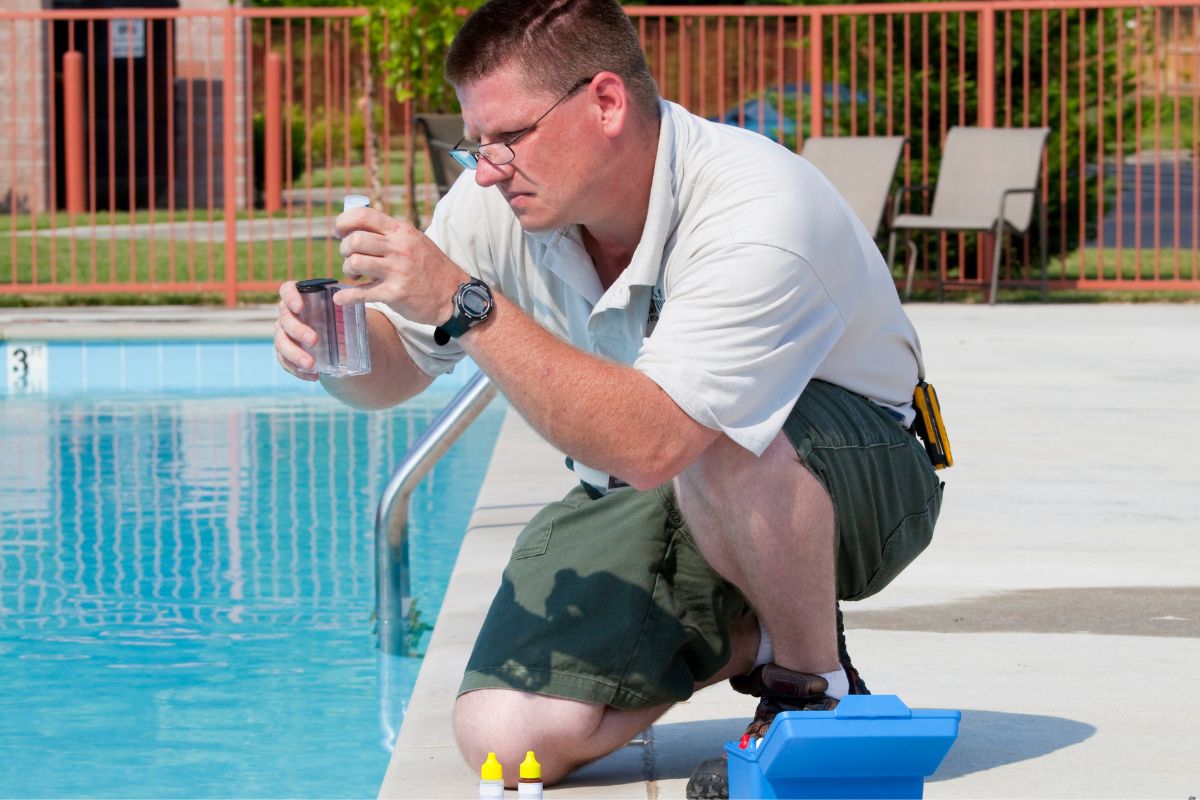
Use a quality test kit to get a clear picture of your water chemistry. You need to know your free chlorine, total chlorine, pH, and CYA levels. We have a great guide on How to Test Pool Water, if you need some tips for accurate home testing.
- If the total chlorine is much higher than free chlorine, you have a buildup of ineffective chloramines.
- If your CYA is above 80–100 ppm, your pool is likely over-stabilized
- If your pH is above 8.0, your chlorine’s sanitizing power is reduced
These numbers will tell you whether to focus on shocking away chloramines, diluting high CYA, or both.
Chlorine lock is rare and is often confused with other pool chemistry issues. Make sure you fully understand what’s going on in your pool before moving forward.
Read more: What Is Chlorine Lock?
Step 2: Balance pH and Reduce Stabilizer (If Needed)
Before shocking, you must prep the water. Pool pro Jeremy Yamaguchi, CEO of Cabana, explains that “to break chlorine lock, it can help to partially drain the pool and refill it. This helps to adjust pH and dilute CYA levels in your pool pretty effectively, and from there it’s easier to effectively shock the pool and get levels back to normal.”
- Adjust the pH to the 7.2–7.4 range. This makes the chlorine shock much more effective.
- If CYA is high, you must lower it. The only practical way is to partially drain and refill the pool, as CYA does not break down on its own.
Step 3: Shock the Pool with Unstabilized Chlorine

With the water prepped, it’s time to shock the pool to achieve breakpoint chlorination. The goal here is to raise your sanitizer levels drastically, and you can learn more about the methods in our guide on How to Increase Free Chlorine in Your Pool.
Yamaguchi advises that “using unstabilized chlorine tends to work best.” For this reason, use a strong, unstabilized chlorine shock like Cal Hypo or liquid chlorine to avoid adding more CYA.
If you’re wondering why shock differs from normal chlorination, read our Shock vs. Chlorine: What’s the Difference? article for in-depth information.
To calculate the dose, the simplest rule of thumb is to triple-shock the pool, which is about three times the normal dose. This is about 3 pounds for every 10,000 gallons of water for Cal Hypo.
For a more precise approach, you can raise the free chlorine level to ten times the amount of your combined chlorine reading. For example, if your CC is 2 ppm, you must add enough shock to raise the free chlorine level to 20 ppm.
Yamaguchi gives us one last tip: “Make sure to do this at night.” Shocking at night helps protect the chlorine from sunlight. Run the pump for at least 8 to 12 hours after shocking to ensure the chlorine is distributed thoroughly.
Step 4: Retest and Repeat if Necessary
After letting the shock work overnight, retest your water:
- You should now see a solid free chlorine reading and a combined chlorine level near zero (below 0.2 ppm). If so, you’ve broken the lock.
- If free chlorine is still zero or CC is still high, you may need a second round of shock.
- Once the lock is broken, brush and vacuum any dead algae or debris. Don’t let anyone swim until the free chlorine level has returned to a safe 1–4 ppm.
How to Prevent Chlorine Lock
Test Your Water
Stay on top of your free chlorine, combined chlorine, pH, and CYA levels. Yamaguchi says, “The best preventative measure is simply testing your pool water regularly. Instead of testing it weekly, try to test it daily or at least every other day.” This frequency lets you spot any issues before they become problematic.
Maintain Proper Chlorine Levels

Don’t let your free chlorine repeatedly crash to zero. It’s easier for the pool to develop a demand (or algae bloom) if you allow chlorine to bottom out. Aim to keep free chlorine in the recommended range at all times.
“From my experience, the most ideal range is between 2–3 ppm, though you’re usually okay down to 1 ppm or up to 4 ppm,” Yamaguchi notes. He cautions that “once it gets to 5 ppm and up, irritation can become significant,” so more is not always better.
If you need help on dosing and frequency, check out our How to Add Chlorine to Your Pool and How Often to Add Chlorine to Your Pool guides for more in-depth information.
Shock on a Schedule
Regular shocking of your pool water helps break down chloramines and organic waste before they accumulate. During peak season, after heavy rainfall, a big pool party, or any event that dumps extra contaminants in the pool, give it a shock treatment. This will prevent chloramine buildup, so you’ll rarely, if ever, see a chlorine demand crisis.
Practice Good Pool Hygiene

The cleaner you keep your pool, the less your chlorine has to fight, and the less likely you’ll experience chlorine demand. Skim out leaves and debris, vacuum regularly, and keep your filter running. Also, encourage swimmers to shower before swimming to rinse off sweat, lotions, and oils because they’ll use up chlorine quickly and create chloramines.
FAQ About Fixing Chlorine Lock
No, the chlorine lock won’t resolve on its own. You’ll need to either shock or dilute the pool to restore chlorine effectiveness.
Yes, resolving the chlorine lock usually kills algae, too. The shock process eliminates both chloramines and algae when done properly.
The easiest fix is to drain and refill the hot tub, then shock with unstabilized chlorine. This will reset stabilizer levels and restore the sanitizer’s effectiveness.
Breaking the Chlorine Lock
If your pool’s chlorine seems “stuck” and ineffective, the solution usually comes down to two approaches: shocking the pool with a strong dose of chlorine or partially replacing the water.
If you’ve tested, balanced, shocked, and still feel unsure or just want an extra set of expert eyes, we can help you connect with experienced pros in your area who can quickly identify and fix any issues with your pool.
Home Gnome delivers the best home service experience at the click of a button. Book reliable, skilled services in seconds and leave the rest to us.
Read More
Main Photo: A man is performing a water quality test next to a pool. Image Credit: Ernest Prim / Adobe Stock
Related Posts: