Your pool is a living environment, and its chlorine needs are affected by everything from a sunny day to a pool party. The secret to a clear, safe pool is a flexible routine that responds to your pool’s constantly changing conditions.
You should test your water every few days and add chlorine as needed to maintain the proper levels.
Standard Chlorination Schedules

This is your baseline. It’s the routine you follow when everything is calm and normal. The foundation of any good routine is consistent testing. You can’t know what your pool needs if you don’t measure it. If you’re looking for step-by-step instructions, check out our guide on How to Add Chlorine to Your Pool.
As Jeremy Yamaguchi, CEO of Cabana, explains, “The frequency at which owners should dose chlorine in the summer can vary depending on their pool. Ideally, you want to be testing your water at least weekly or every couple of days.”
Your goal is to keep the free chlorine level in a safe and effective range. According to Yamaguchi, there’s a clear sweet spot. “From my experience, I find that the most ideal range is between 2–3 ppm, though you’re also usually okay to go down to 1 ppm or up to 4 ppm,” he says. “Once it gets to 5 ppm and up, irritation can become significant.”
Read more: How to Increase Free Chlorine in Your Pool
Here’s how the basic schedule breaks down by chlorine type based on CDC guidance:
| Type | Dose Frequency |
| Standard chlorination | Daily or as needed to maintain >1 ppm free chlorine (> 2 ppm if CYA used) |
| Chlorine tablets | Refill regularly via feeders based on test results |
| Liquid chlorine | As needed, based on test results |
| Granular chlorine | As needed for quick boosts based on tests |
| Shock treatment | Daily to weekly, especially after heavy use |
| Super-chlorination (breakpoint) | When combined chlorine > 0.4 ppm |
Chlorine tablets (Trichlor/Bromine): They release chlorine gradually, so you might only need to refill floaters or chlorinators once a week or so. This evens out the chlorination over time.
Liquid chlorine (Sodium Hypochlorite): It’s fast-acting but unstabilized, so sunlight often consumes it faster. This usually means adding smaller doses more frequently unless you have sufficient stabilizer in the water.
Granular chlorine (Cal-Hypo/Dichlor): This category includes two very different products that are typically added by pre-disolving them in a bucket of pool water:
- Dichlor: Like tablets, Dichlor is a stabilized form of chlorine that contains CYA. It dissolves quickly and is often used for a quick chlorine boost.
- Cal-Hypo: This is an unstabilized granular chlorine, most commonly used as pool shock. It is very effective at quickly raising chlorine levels to eliminate contaminants.
How Often to Add Chlorine to a Saltwater Pool

This is a common point of confusion I’ve seen on forums. First, let’s be clear: saltwater pools are chlorine pools. The difference is that you have a mini chlorine factory, the SWCG, hooked up to your plumbing. Instead of you adding chlorine, the SWCG uses electrolysis to convert salt in the water into chlorine.
How often do you add chlorine? You don’t. At least, not for daily maintenance. Instead, your routine is about managing the generator:
You don’t add chlorine; you adjust the generator. You’ll test your free chlorine level weekly and adjust the generator’s output percentage up or down to keep your free chlorine in the 1–3 ppm range.
You still need to shock the pool. When the generator can’t keep up with demand (like after a party or a storm), you’ll need to give it a boost. Most SWCGs have a “Super Chlorinate” or “Boost” function that runs the cell at 100% for 24 hours. This is your weekly or as-needed shock.
Factors That Determine Chlorination Frequency
Why the standard schedule is just a suggestion: your pool lives in a dynamic environment, and these factors will force you to adjust your routine constantly:
Sunlight: This is the number one chlorine killer. In just two hours, UV rays can destroy up to 90% of your pool’s unstabilized chlorine on a bright, sunny day. This is why CYA, or a stabilizer, is so important. It acts like a sunblock for your chlorine, protecting it from the sun. Without the right CYA level (30-50 ppm is a good target), you’ll add chlorine constantly to keep up.
Pool usage (bather load): Every person who jumps in your pool introduces sweat, oils, sunscreen, and other organic compounds. These things create what’s called “chlorine demand”: they use up your free chlorine, leaving less available to sanitize the water.
Hot weather: The warmer the water, the faster bacteria and algae grow, and the more chlorine is needed to fight them. Chemical reactions also speed up in warmer water, meaning your chlorine works faster but also gets used up faster. A good rule of thumb is that for every 10°F rise in temperature above 80°F, your chlorine consumption can nearly double.
Rain: A heavy downpour can throw your whole chemistry off. Rainwater is often acidic and will dilute your pool water, lowering the concentration of all your chemicals, including chlorine and stabilizer. It also washes dirt, pollen, and other debris into the pool, increasing chlorine demand.
Debris: Leaves, pollen, grass clippings, and dirt all consume chlorine as they decompose in the water. The cleaner you keep your pool, the less work your chlorine has to do.
Water quality: The water you use to fill your pool isn’t always a clean slate. If you’re on well water, it can contain metals or other contaminants. Even municipal water can have high levels of chloramines, which create an immediate chlorine demand from the moment you turn on the hose.
pH levels: Controls chlorine’s effectiveness. Even if chlorine tests perfectly, a pH above 7.8 makes it lose much of its sanitizing power. A low pH (acidic) causes chlorine to dissipate too quickly and can corrode your pool equipment.
Special Circumstances That Require More Frequent Chlorination

Your weekly routine is just for normal conditions. Some specific situations drain your chlorine levels and require an immediate response, usually shocking. If you’re not sure about the difference, check out our Shock vs. Chlorine: What’s the Difference? article.
Opening and closing your pool: Always shock your pool as part of your routine. When you open it, you’re waking it up from a long winter nap, and it’s likely full of bacteria and algae that grew while it was dormant. When you close it, a final shock helps keep the water as clean as possible during the off-season, making your job easier next spring.
Chloramines: If total chlorine exceeds free chlorine by more than 0.4 ppm, it means chloramines (smelly irritants) have built up. CDC recommends “superchlorination” to break them down.
Fecal incidents: For a typical backyard pool, raise free chlorine to 2 ppm, keep the pH at 7.5 or less for half an hour.
Note: If you keep adding chlorine but your free chlorine stays at near zero, you might have a “chlorine lock.” Yamaguchi notes that true chlorine lock “doesn’t happen too often,” but it’s usually caused by over-stabilized water where your CYA level is too high, which prevents the chlorine from working.
Signs Your Pool Needs Chlorine

Your pool will give you a clear signal when it needs attention. Learning to spot these signals will help you act before a small issue becomes a big, green problem:
Test kit: The most obvious signs are in your test kit. If your free chlorine reads zero, you have no sanitizer. If your test shows high total chlorine, but low free chlorine, it confirms you have a high level of smelly, ineffective chloramines and need to shock.
Cloudy water: This is often the first sign that your sanitizer level is dropping and can’t keep up with the contaminants.
That “pool smell”: This is the most misunderstood sign. A strong chemical smell doesn’t mean you have too much chlorine; rather, it indicates that you don’t have enough working chlorine. The only way to break them apart and get rid of the smell is to shock the pool.
Slimy surfaces: If you run your hand along the pool wall or steps and it feels slimy, that’s biofilm and a sure sign your chlorine level is too low.
Green, yellow, or black spots: This is visible algae. If you see it, you’ve already lost the battle and need to act fast with brushing, shocking, and possibly a dedicated algaecide.
A pro’s take on too much chlorine: “When a pool is over-chlorinated, you can often smell it. If you notice the chlorine smell is a lot stronger than normal, take note of that.” If you find yourself in this situation, read our guide on How to Lower Chlorine Levels in Your Pool.
Stay Ahead of the Splash
There is no substitute for a consistent routine of testing your water. Learn how it reacts to a sunny day, a rainstorm, or a dozen swimmers. Soon, you’ll move past the simple question of “how often” and develop an instinct for exactly what your pool needs, and when.
Home Gnome delivers the best home service experience at the click of a button. Book reliable, skilled services in seconds and leave the rest to us.
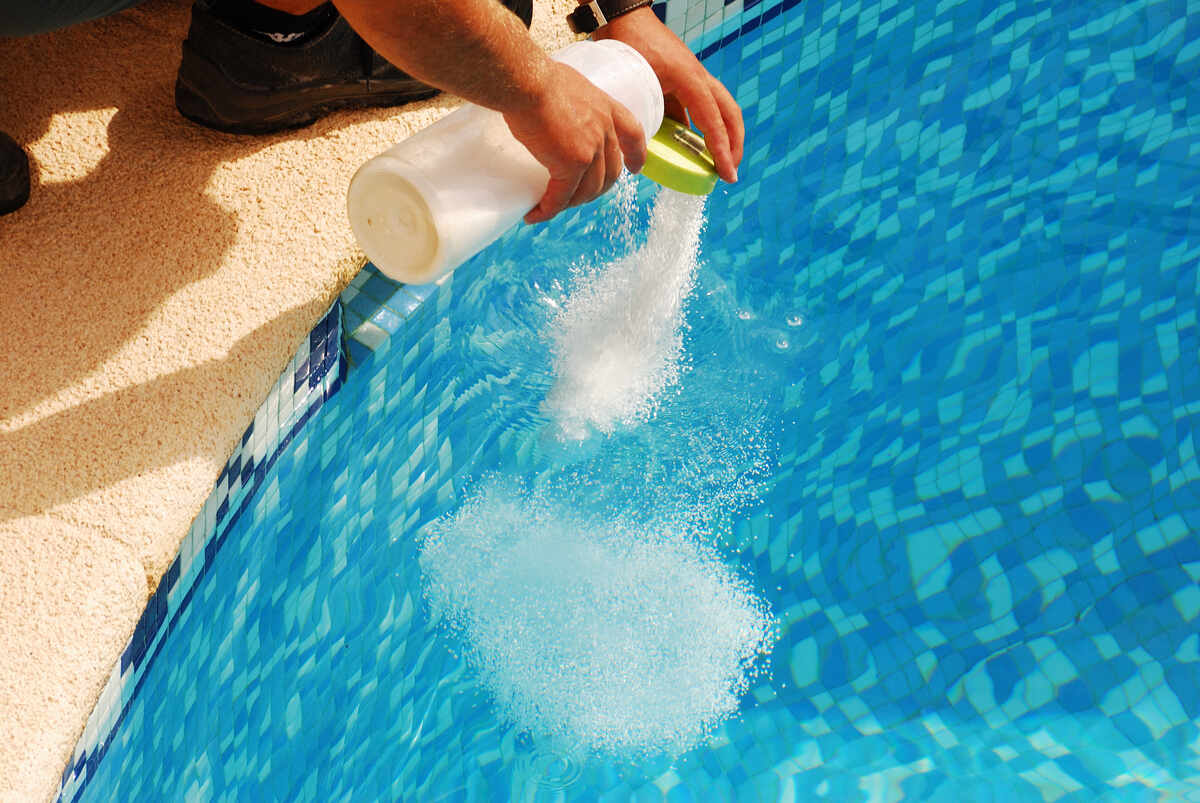
Main Image: Person adding chlorine to pool. Image Credit: GoodPics / Adobe Stock
Related Posts: